

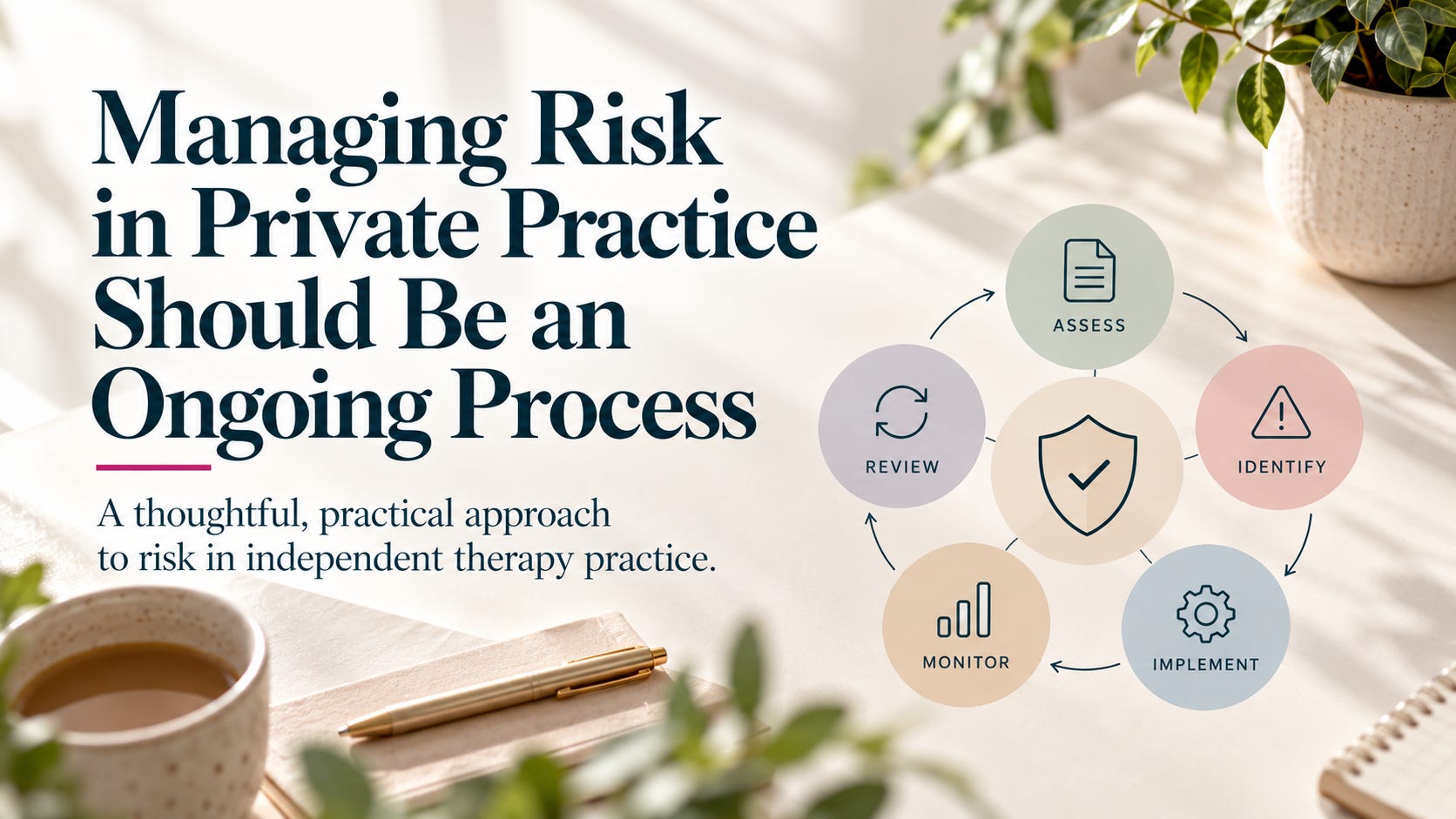
When it comes to managing risk, I don’t think it’s a lack of knowledge that most therapists are struggling with. It’s the absence of a framework. In an organisation like the NHS, the structure around risk is built for you. In private practice, it only exists if you build it yourself.
Without a framework, you might be confident with risk in the therapy room, but anxious the minute you step outside. ‘Have I missed something? Would I know what to do?’ Sound familiar?
As therapists, our job is not to predict the future or eliminate uncertainty. It’s to have a clear process for noticing change, reviewing what’s needed, seeking support and responding appropriately.
📌 Read Why You Shouldn’t Be Afraid of Managing Risk in Private Practice to learn more.
Ongoing Risk Assessment Needs Both Rhythm and Response
For years, risk felt like something I reacted to. What changed wasn’t my clinical skill. It was putting a framework in place, building a rhythm around it, and reviewing it every year. Now I know it’s up to date, considered, and in the best interests of both my clients and me.
Remember, rhythm alone is rigid and response alone is reactive. A private practice needs both.
The rhythm is what you review on a schedule, so nothing drifts. The response is what you do when something changes, because risk doesn’t wait for your annual review.
6 Reasons Risk Assessment Needs to Be Ongoing
1. Clients change. Circumstances, presentation and support shift. Someone may be entirely suitable for private therapy at assessment, and then their needs or level of risk change.
2. Your practice changes. New client groups, moving online, a new room, a fuller caseload.
3. Guidance changes. NICE, professional bodies, safeguarding pathways and data legislation all get updated. Your policies don’t update themselves.
4. You change. Capacity, wellbeing, life events.
5. Things drift naturally. Contact details go out of date, supervision becomes general catch-up, training lapses.
6. No one else is doing it for you. If you don’t schedule it, it doesn’t happen. Memory and goodwill aren’t a system.
What Your Ongoing Framework Needs to Cover
What do you gather at enquiry? What are your consultation-call boundaries? What happens if significant risk is disclosed before someone is even your client?
📌 Read Managing Risk in Private Practice Starts Before You Even Meet the Client to learn more.
What is your practice set up to hold? Not ‘which clients are risky?’ but what your particular practice can reasonably support, given your competence, availability, systems and backup. Suitability isn’t a one-off decision. It needs revisiting as things change.
What’s your process when things change? Rather than making it up in the moment, know what you’d review, who you’d consult, and what options you have.
How will you make review part of normal practice? It’s easier to respond calmly when review is built into how your practice runs. You don’t have to work everything out from scratch.
If this has got you thinking, the two-part Risk Management in Private Practice training on 3rd and 10th November is where we build the whole framework. Early bird £97 until 20 October.
Below the paywall, you’ll find a checklist I’ve designed to help you consider whether your private practice has an ongoing process around risk, or whether parts of it need strengthening.