

Why the algorithm picked it, what the saves told me, and what I’d post if I were starting a private practice from scratch.

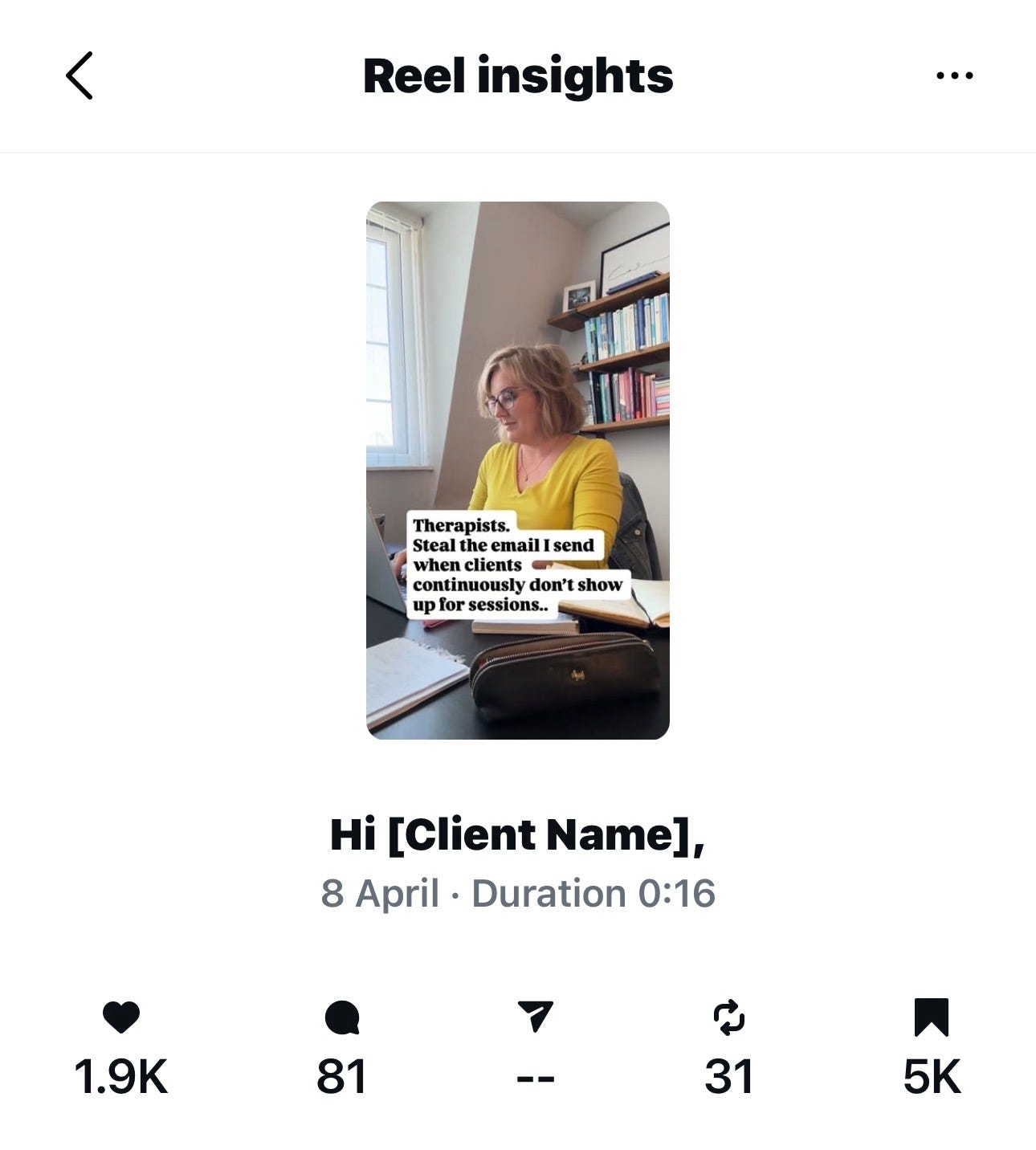
My Reel went up eleven days ago. It now has 210,353 views, 5,017 saves, 845 new followers and 99.1% of the people who saw it weren’t following me yet.
I want to take you behind the scenes. Not for a victory lap but a working dissection. What the Reel actually was, why the algorithm pushed it, what made it convert strangers into followers, and the bit almost no one talks about openly: how to handle the wave of disagreement that comes with reach, because I know that there’s a few therapists using social media to improve visibility and more visibility means more clients, the approaches we discuss will work across the platforms.
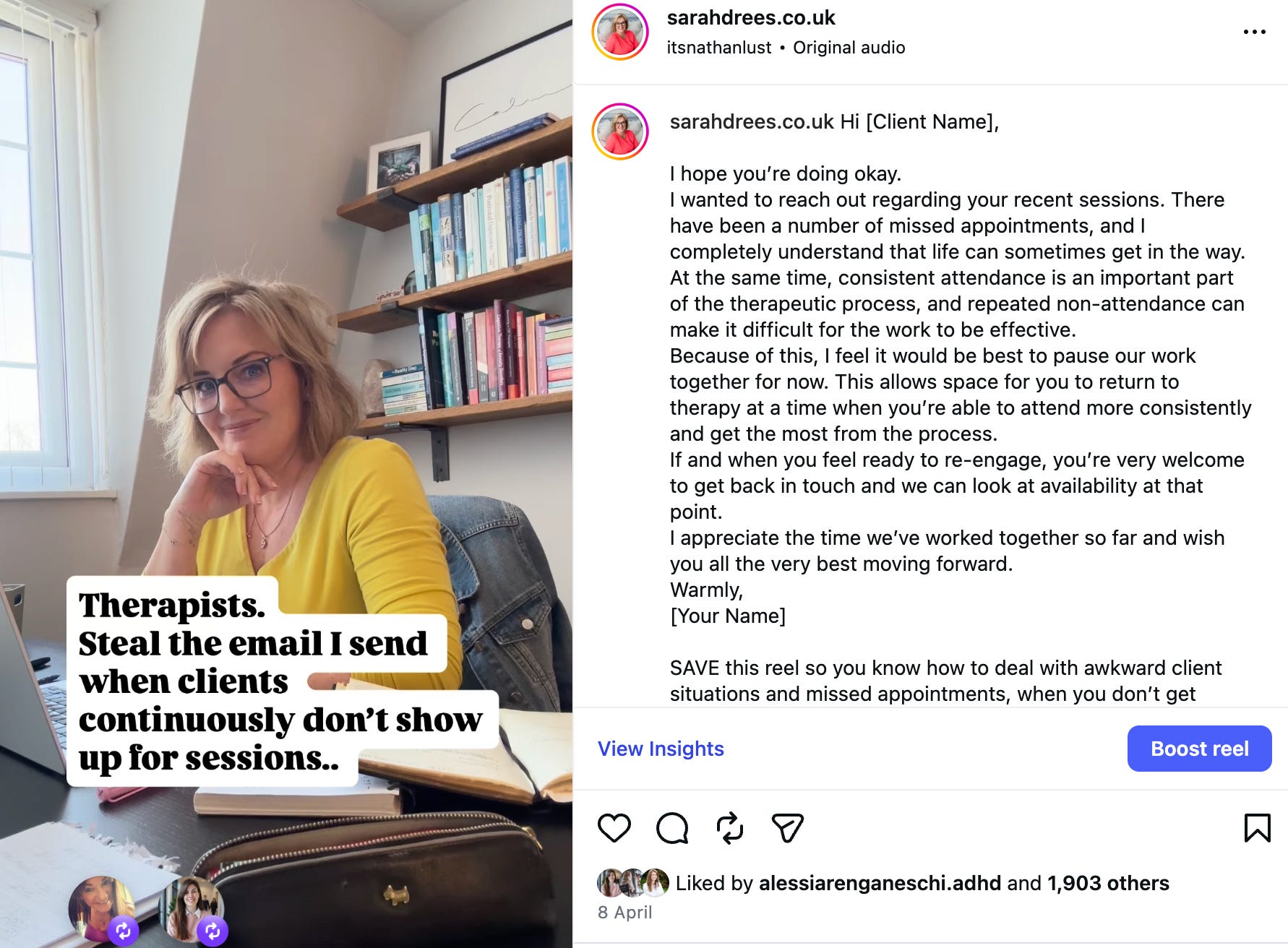
The Reel
Thirty seconds of text on screen.
The hook: ( to get attention)
Therapists. Steal the email I send when clients continuously don’t show up for sessions.
The body was the email itself — a script you could literally copy, paste, and adapt. The closing card said: SAVE this email
The number that matters most isn’t the views. It’s the saves.
5,017 saves to 1,904 likes is a 2.6:1 ratio, the inverse of a typical Reel, where saves usually trail likes by 1:5 or 1:10. Saves appear to be one of the strongest signals Instagram weights right now, because a save says “I want to come back to this” and the algorithm reads that as durable value worth distributing. That ratio is the entire reason this Reel travelled.
Why it went viral — three mechanics
One: it was built to be saved. The content was a copy-paste-able resource (the email itself), the word “steal” gave permission to take and reuse it, and the closing card directly told viewers to save it, with a clear reason why. If you remember nothing else from this post, ask yourself: would someone screenshot this, save it, or send it to a colleague? If no — change it before you post.
Two: the hook didn’t waste a second. Eight words on the first frame did four jobs at once: named the audience, granted permission, promised a deliverable, and located the deliverable inside a real, recurring problem. No preamble. No “Hi guys, today I want to talk about...” The Reel earned the next 28 seconds in the first two.
Three: it solved one sharp, awkward, common problem. How to handle clients who repeatedly don’t show up is a problem almost every therapist has, almost nobody is trained on directly, and most are quietly winging in their inbox. Vague advice is dead online. Specific and relatable advice travels. The narrower and more uncomfortable the problem, the more shareable the solution.
The disagreement comments and why they’re a feature, not a bug
Now the part I want you to read twice.
The Reel got a sustained run of critical comments. The most-liked one (74 likes) said, in essence: this email makes assumptions, you should check in with the client first rather than assume avoidance, sometimes people aren’t avoiding therapy intentionally, sometimes depression makes getting out of bed impossible. It’s a fair point. I replied, thanked them, agreed we shouldn’t assume and I then committed to a follow-up post.
Notice three things about that exchange.
The disagreement is part of why the Reel reached 210,000 people. Instagram rewards engagement of any kind, disagreement included, because it keeps people on the app. Content engineered to never offend anyone gives the algorithm nothing to push. When you try to appeal to everybody, you appeal to nobody and to the algorithm, nobody is invisible.
Criticism is information, not a verdict on you. The critique improved my next post. The follow-up I did is Here
Any critisism does sting at first, that’s normal. I want to be honest about this, because softening it would be unhelpful. In the early days, the critical comments I got did really bother me. I’d reread them. I’d feel the flush of shame. I’d close the app and not post for a week. It stops being uncomfortable eventually, but only with reps. This is, in the end, an exposure exercise. You know the protocol avoidance is what maintains the fear. I can honestly say it really doesn’t impact me anymore.
What I haven’t shared yet is the underlying template, the one I use to engineer save-and-share content on purpose, not by luck and the three Reels I’d post this week if I were a therapist trying to fill my caseload from scratch.
Both are below.